
Amazon says the average cost per click on Sponsored Ads has, adjusted for inflation, stayed flat since 2019. At the same time, every seller I talk to complains about the cost of advertising being brutal these days. So what is going on?
The FTC’s lawsuit is the reason why this is in the news right now, and I’ll get to it. However, the more interesting question is why Amazon sellers feel squeezed, despite CPC being stable. My take is simple, CPC was never the only number that mattered, and I’d even say CPC is not the most important one. In reality, several factors contributed to this “ad burden” feeling among sellers, regardless of this one metric.
The lawsuit and why a flat CPC is a narrow defense
Let me give you a short summary of the lawsuit involving Amazon and the FTC. The FTC alleges that Amazon introduced an undisclosed reserve price to ad auctions, back in 2019. This change basically made advertisers pay closer to their own bid instead of the next-highest one. Advertisers thought they were getting into a second-price auction, but it was actually closer to a first-price one. Amazon disputes this claim, and explains that the average CPC, adjusted for inflation, stayed flat since 2019.
I can’t tell who is right, I don’t have access to enough information, and I don’t know how a court will see these internal auction mechanics. But I want to bring attention to something the news did not fully cover, if at all. Even if Amazon’s CPC data is correct, it does not address all of the seller’s concerns. CPC tells you what you pay for a click, but says nothing about how many clicks you now need to reach the same revenues you used to get organically in the past. It also does not tell you what happens to your sales the moment you stop bidding. CPC can stay flat, but what if you are forced to spend more every year, as your organic sales drop? Price is not changing here, but volume is what matters. I wrote about this exact dynamic back in 2023, following the FTC’s antitrust suit against Amazon. Even then, more than half the search page was ads. The pattern isn’t new, it’s just in court again.
What’s actually changed despite the flat CPC
Three things have changed over the years, but are part of the same complaint from Amazon sellers.
First, ads used to be a growth lever, something to jumpstart a new listing or increase sales on something that was already selling well. For a lot of sellers now, especially in competitive categories, ads are necessary just to not become invisible. That shift is a result of how much of the search results page is now ads.
This causes the second issue. With more ads in the search results page, the ratio of organic to paid sales is lower, especially for newer products without the organic visibility of current category leaders. A listing that could have climbed to page one organically in a few months five years ago now has to spend a lot more on ads to achieve the same result today.
The last issue and result of the two is margin compression. Advertising went from a discretionary line item to an unavoidable growing expense, and a bigger share of the P&L. This is especially painful as pressure on pricing on Amazon can be another source of frustration. Brands can’t just increase prices to absorb these costs, because of elevated competition but also Amazon favoring lower prices. The combination of increased ad dependency, increased total ad spend, and limited pricing power, is what actually causes the frustration. Not cost-per-click.
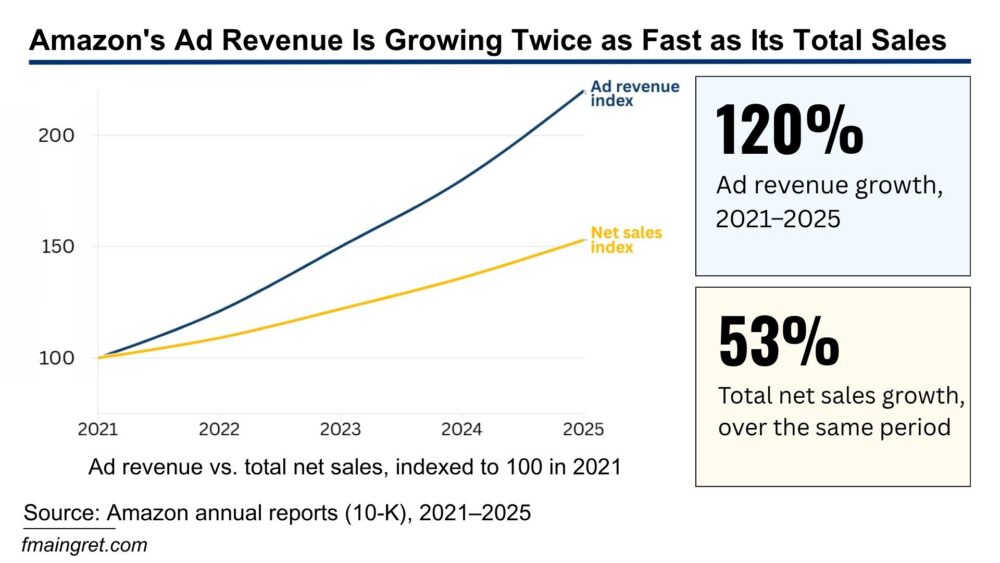
Now most of the hard data on how much sellers spend on ads is not public. However I found something interesting in Amazon’s own earnings reports. Amazon’s advertising revenue went from $31.2 billion in 2021 to $68.6 billion in 2025, a 120% increase. At the same time, total net sales over the same period went from $469.8 billion to $716.9 billion, up 53%. Advertising revenue grew more than twice as fast as the business. Ads also went from about 6.6% of total net sales in 2021 to 9.6% in 2025. None of that requires CPC to move at all, it only takes more ad inventory to get sold.
Why this matters regardless of the lawsuit’s outcome
Whether the FTC wins or loses, the structural shift in how ad cost affects sellers is still there. What’s happening is that Amazon is increasing its own revenues through advertising, where organic reach used to give sellers a larger share of the pie. The lawsuit made these concerns public and legible, and gave sellers who already felt something was off a target, whether it is true or not.
If you run a business on Amazon, or any platform where ads are necessary, the takeaway I want you to remember from this post is to stop seeing CPC as your health metric. Ad spend as a % of revenue over time should of course be tracked and monitored. But what some businesses tend to miss is what happens to organic ranking once you decrease ad spend. This isn’t specific to Amazon or to any category, the same pattern can apply to any platform.
The better positioned sellers see ad cost as the cost of doing business on Amazon. They’ve built their business so that margins are healthy enough to support this cost. More importantly, they spread revenue and acquisition across multiple channels, so a bad quarter on Amazon does not kill the whole business. Having built enough brand equity that organic sales keep coming in is what prevents many of these businesses from struggling under rising ad costs.
Where this leaves us
The lawsuit may clarify the auction mechanics, but won’t change the economics sellers have to deal with. The shift in economics happened way before this suit was filed, and will still exist after the lawsuit is resolved, regardless of the outcome.
Sources: FTC v. Amazon complaint (Aug. 2026), Amazon’s public response (aboutamazon.com), Amazon quarterly and annual earnings releases (ir.aboutamazon.com).