
Most books addressing ecommerce distribution are giving you a play-by-play guide on how to enter channels. Fewer are telling you how to evaluate them and how to sequence them. But the part that is the most overlooked, and arguably just as important, is to figure out when to exit a channel. Staying in the wrong channel can cost your brand just as much money as entering the wrong one, and that is why I would like to conclude this book with this difficult but necessary topic.
Knowing when to leave
I have told you that brands often make mistakes when entering a channel. That is true, but most reasonable managers are still doing enough research that the decision is based on logical arguments. On the other hand, the conversation about exiting a channel is often less rational. Many brands want to delay or avoid even discussing it, usually after the damage is already done. The sunk cost is real, the internal politics can be messy, and people will always find a reason to give it one more quarter. By the time the exit decision feels obvious and necessary, the channel has often been quietly destroying value for quarters or even years.
This chapter is about building the habit of looking for the right signals, understanding when difficulties are temporary versus permanent, and knowing how to exit cleanly when needed.
The Channel Used to Work, but Doesn’t Anymore
No channel stays the same forever, which is why ecommerce is both exciting and exhausting. The platform you entered five years ago now has different economics, a different competitive landscape, the algorithms and the audience have changed. But it isn’t just about the channel, your business has probably changed too. Maybe your brand positioning has evolved, or your customer moved on to other channels.
The mistake here is to evaluate a channel based on why you entered it over what it looks like today. The original business case probably makes sense, but if you had to do it all over again today, would it be the same? As we have seen in the Anker case study, the brand entered Amazon in 2011 when it was wide open with little competition and low advertising costs. That decision made a lot of sense back then, but for a newer brand today, it could be a disaster.
I am not telling you to exit a channel when things get harder. Almost every channel eventually gets harder over time as competition increases. But the question is whether the channel still makes sense today or does the brand and environment have changed too much
The Signals You Should Be Monitoring
By now, you probably know that the most expensive channel mistakes are not the louder ones. If your revenues collapse overnight on a channel, you’ll probably make it a priority to investigate and fix. But what is dangerous is when the decline is slow, each individual data point looks manageable. This goes on for years until you zoom out on the revenue chart and realize it’s been downhill for the past seven quarters.
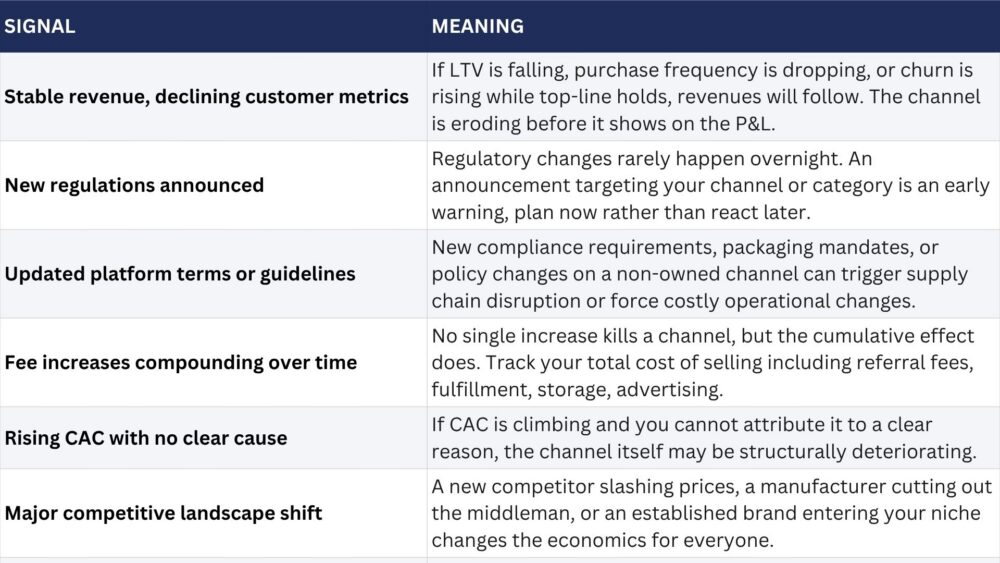
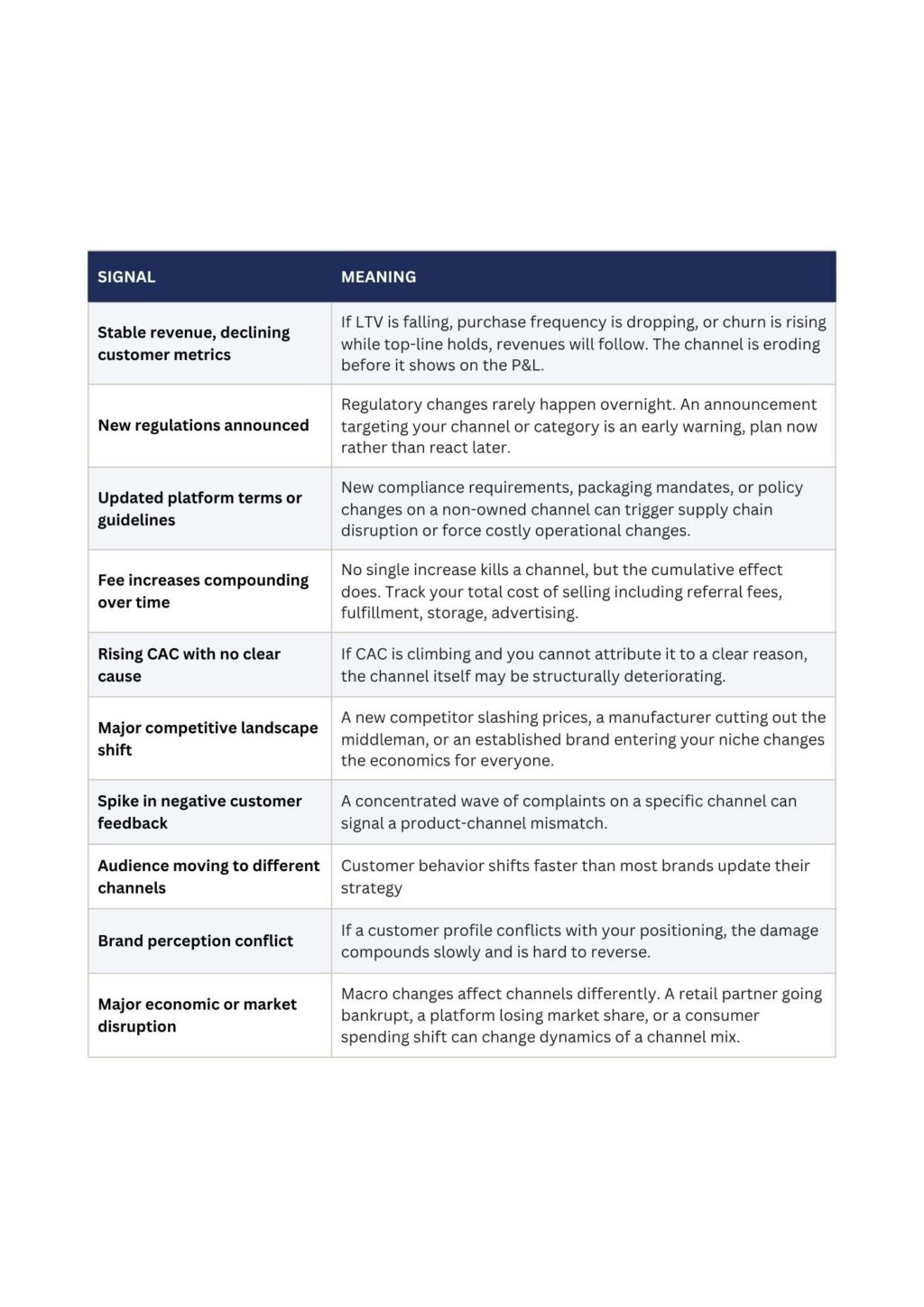
There are two categories of signals brands should monitor. The first and obvious ones are drops in revenue or profitability. Most businesses track these already. The second category are the subtle signals that show up six months or even a year or more before the obvious ones, the yellow light that tells you you should monitor something more closely. Here are a few examples.
Stable revenue but declining customer metrics
You can, for example, start to experience stable revenue but declining LTV. If your top line is holding but your customers are buying less frequently, spending less per order, or churning faster, something has changed and will impact revenue pretty soon. Maybe revenues are still holding because of timing or because of temporary lower CAC. But either way, this is not something you want to see and you must act today, not tomorrow when revenue declines.
New regulations
There are many other situations worth discussing here. You may hear the news mention new regulations that can impact your business. That doesn’t mean it is time to panic, but at least reflect on how you’ll be impacted. TikTok’s regulatory situation in the US was uncertain for years before it became an urgent problem for businesses that relied on it heavily. Meta’s advertising capabilities changed significantly after an iOS privacy update in 2021. These can happen overnight, but sometimes are announced well in advance.
New guidelines and updated terms of services
For non-owned channels, brands often experience new platform guidelines or policy changes. The terms of services or compliance requirements are never fixed, and can be painful but can’t be ignored. A new requirement on packaging from Amazon can mean massive supply chain disruption for your brand if you act on it last minute.
Cost updates and fee increases
Amazon has raised its FBA fees significantly over the past several years, and does so frequently. These increases hurt because they accumulate gradually. Sellers think they can manage one increase, but the question is, how many increases can they manage? Are the fees increasing faster than their prices? And these fees can be non-obvious. Sellers using Amazon FBA often focus on fulfillment and referral fees, but don’t look at the cost of storage, returns or ads over years. Track your total cost of selling on each channel, not just the referral fee percentage.
Increasing CAC with no clear cause
If your customer acquisition cost is rising and you cannot explain why through campaign performance or clear market conditions, the channel itself may be becoming a losing bet for your brand. Factors like increasing competition, algorithm changes, or audience saturation can all increase your CAC in structural ways that you could not fix.
Major shifts in the competitive landscape
A new competitor entering your category and slashing prices, or an existing competitor making major strategic moves will change the dynamics for everyone. This was the case in 2021 when Chinese suppliers started cutting the middlemen on Amazon and pushed prices down. These shifts are concerning, because they rarely affect only one channel. Competition will always exist and is something brands must deal with, but it can sometimes shift in a way that kills your ability to win on that channel, at least until you make structural changes to your business.
An influx of sudden negative feedback
Any spike in negative reviews, customer complaints, or social media criticism is worth investigating. Rarely brands will experience these concentrated on a specific channel, but that can happen. It could be a supply chain or product issues, like a bad batch of products shipped to a retailer. There is always a possibility of a mismatch between what the channel’s audience expects and what your brand delivers. Customers now expecting faster shipping that your DTC can’t deliver is an issue worth discussing.
New customer behavior or emerging trends
Customer behavior changes faster than most brands update their channel strategy. If a good part of your target audience has moved to a platform or a shopping behavior that your current channel mix does not address, you have a gap that will only grow larger over time.
Shifting brand perception
If your brand is starting to be associated with a channel in a way that conflicts with your positioning, that is a signal worth taking seriously. If your brand positioning is shifting towards luxury, it may be time to drop eBay and Amazon and focus on DTC and retail. Brand perception is painfully slow to build and fast to destroy, so make sure your channel mix reflects it.
Major economic changes
Finally, economic conditions and changes in consumer spending behavior affect channels differently. The changes are rarely dramatic on the channel mix, but can happen, like a major retail partner going out of business.
Now, none of these signals alone means exit immediately, otherwise you’d be left with zero place for selling your products. But when any of them show up consistently over multiple quarters, I recommend scheduling a strategic review.
Temporary Disruption Versus Permanent Change
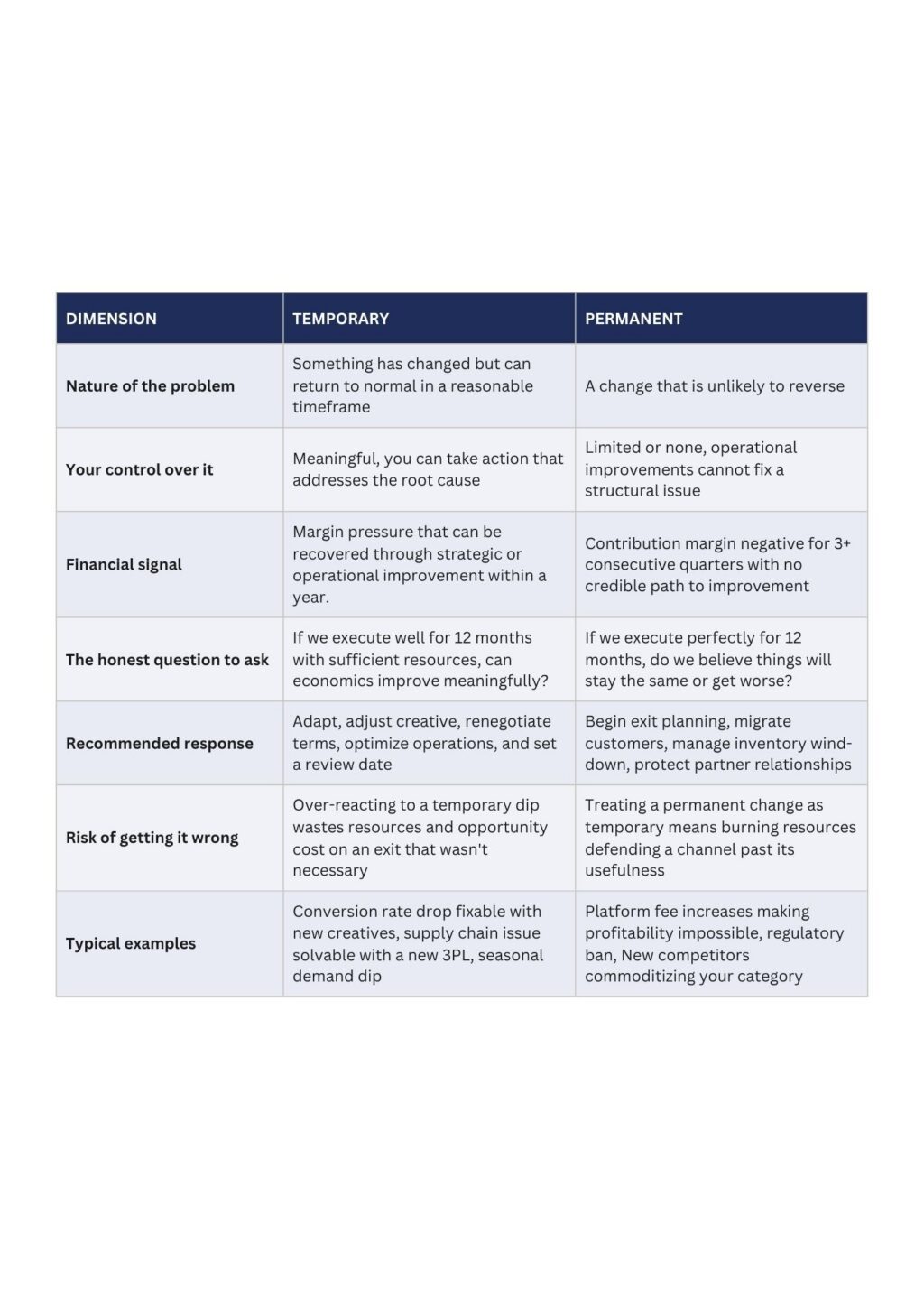
When you spot a signal, an important question is whether what you are seeing is just some temporary disruption, or a permanent structural change. The answer will determine whether you need to adapt and wait, or consider planning an exit.
Temporary disruption is something that has changed but can go back to normal in a reasonable time frame, or something that you have meaningful control over. It could be a drop in conversion rates that you can address with new creatives, or supply chain issues that can be fixed by working with a new 3PL partner.
On the other hand, permanent structural change is a change that is very unlikely to go back to normal, and/or that you have little or no control over. For example, platform fee increases to the point you can never be profitable, no matter how you change your offer. Or changes in the regulatory landscape that make it literally impossible to sell. Even new competitors can trigger such drastic changes that you can’t compete with.
In the case of permanent changes, the brutally honest question to ask is this: if we execute perfectly on this channel for the next twelve months with sufficient resources, do we believe the economics can get meaningfully better, or do we believe they will stay the same or continue to get worse? If the answer is stay the same or get worse, and the cause is structural rather than operational, you are looking at a permanent change that should lead to a painful conversation.
The Opportunity Cost of Staying Too Long
Until now, we looked at what the channel is costing you directly, in fees and declining revenue. Very important to track, but really only half of the equation.
The other half is the opportunity cost, what you could be doing with those resources instead. Every dollar spent defending a declining channel is a dollar you will not invest in a channel with more potential.
Your P&L has a line for payroll, COGS, advertising expenses, operating costs, etc. But it has no line for this massive opportunity cost. Someone letting their money sit on a checking account over investing it is making a costly mistake, they just don’t know it because it does not appear on their bank statement. And while the mistake doesn’t cost them much over a year, over twenty years it compounds to life changing amounts. The same principle applies here.
A brand that stayed too long on a declining channel for two years lost more than what that channel cost them, they also lost two years of compounding advantage on the better channel they should have built instead. The brands that get this right are the ones that treat resource reallocation as an active strategic decision rather than something that happens only when a channel collapses to the point of no return.
When Enough Is Enough
We have seen the signals you should watch for, but when is it time to pull the trigger? The truth is, only you can decide, as everyone has a different environment, and risk tolerance. What I personally look out for are the following.
The channel shows an increasingly negative contribution margin for more than three consecutive quarters, with no credible path to improvement. Most of the time, it is still early and brands will come up with ideas to address the issue. I agree to some extent, but honesty is key here. If the causes of this decline can’t realistically be fixed, I see it as a sign that it is time to reallocate resources and manage the decline.
The channel requires so much resources to maintain that it is diverting these resources from higher priority opportunities, and the return does not justify it. This will depend on your risk tolerance here, but if the untapped opportunity is really believed to be better in the long run, it is time to act.
A structural change, like a platform, regulatory, or competitive change, has permanently changed the game in a way that makes it impossible to operate. In that case, the decision to divest from a channel can be temporary if these changes can be reversed in the medium term.
The channel is actively damaging your brand in ways that affect your other channels. If the revenue on this channel is not absolutely necessary, and the negative perception prevents growth on other channels, it is time to move on.
When you are in one of these scenarios, I recommend addressing the question immediately. But when two or more of these signals are present at the same time , the exit conversation is an absolute necessity.
How to Exit Without Destroying What You Built
Now you’ve decided staying on a channel isn’t worth it, you’re ready to pull the trigger. Should you just shut everything down immediately and never look back? You could, but I don’t recommend it. A poorly managed exit can damage customer and partner relationships, create inventory problems, and confuse your own team. Here’s what I recommend you do instead.
Customer migration is the first step, and you should have a plan for capturing as many of those customers as possible on a channel you own or control better. This can be done through social media, packaging inserts, email capture, loyalty programs, etc. Basically any customer touchpoint is an opportunity to maintain the relationship after the channel dies. The customers you have built on that channel are still a valuable asset, and keeping them should be a priority. They may even become more profitable customers on other channels they are not used to yet.
Inventory management is something you must discuss with your supply chain team. Pulling out too quickly could cause missing out on the last revenue but more importantly create extra costs. On the other hand, taking too long can involve unnecessary storage costs.
Preserve partner relationships when needed. If the channel involves retail partners, distributors, or platform partners you have built relationships with, manage the exit professionally. The ecommerce and retail world is smaller than it looks and the way you exit a channel relationship today affects how you are perceived in the industry.
Finally, be honest with your team. Channel exits create stress and uncertainty for the people managing those channels. The team that built their careers around a retail relationship or the Amazon specialist who has spent years optimizing your listings deserve honest and early communication about what is happening and what it means for them.
Do not announce the exit before you are ready to execute it, as leaks and early announcements can turn into public signals that you are deprioritizing a channel, and can cause you even more problems when working on the exit.
Key Takeaways
- Most channel strategy content tells you how to enter channels but very rarely when to leave. Getting the exit timing wrong is just as expensive as entering the wrong channel.
- The subtle signals matter most, including declining LTV, rising CAC, regulatory announcements, and shifting brand perception. These can show up a year or more before revenue collapse.
- The critical question when you spot one or multiple red flags is whether the issue is temporary and within your control, or permanent and structural. The answer determines whether you adapt or consider exiting.
- The opportunity cost of staying too long is invisible on a P&L but compounds over time just like any other strategic mistake.