
Last month I wrote about Wayfair’s push into physical retail. The idea there was simple, some people won’t buy a couch without sitting on it first, so a retail store exists to reach these customers. But stores aren’t a free lever, and opening more of them to reach more customers is a lot like raising an ad budget. The returns are strong at first and then quietly fall off a cliff once you’ve already captured the right people. Retail expansion has a ceiling, and going past it without changing the rest of the strategy is a losing bet.
That’s what came to mind when I saw Indochino was opening more stores. I know this space reasonably well as a customer, and believe it will eventually spread to other product categories in the near future. This is why I wanted to reflect on where their ceiling might actually be, what challenges the brand may face before they hit it, and what I’d try if I were running their omnichannel strategy.
2 – Indochino and Their Plan
For anyone not familiar with the company, Indochino is a made-to-measure brand, mostly suits, along with shirts, acessories and outerwear. The model started fully online with no stores, no inventory, and customers got measured (originally by self-measuring at home), could pick their fabric and details, and the garment gets made to order and shipped a few weeks later.
The appeal is easy to see, custom tailoring often made overseas at a much lower cost of what a traditional bespoke suit costs (often ten times less expensive). Over time, Indochino added physical showrooms, not to hold inventory, but to fix the issues that came with self-measurements.
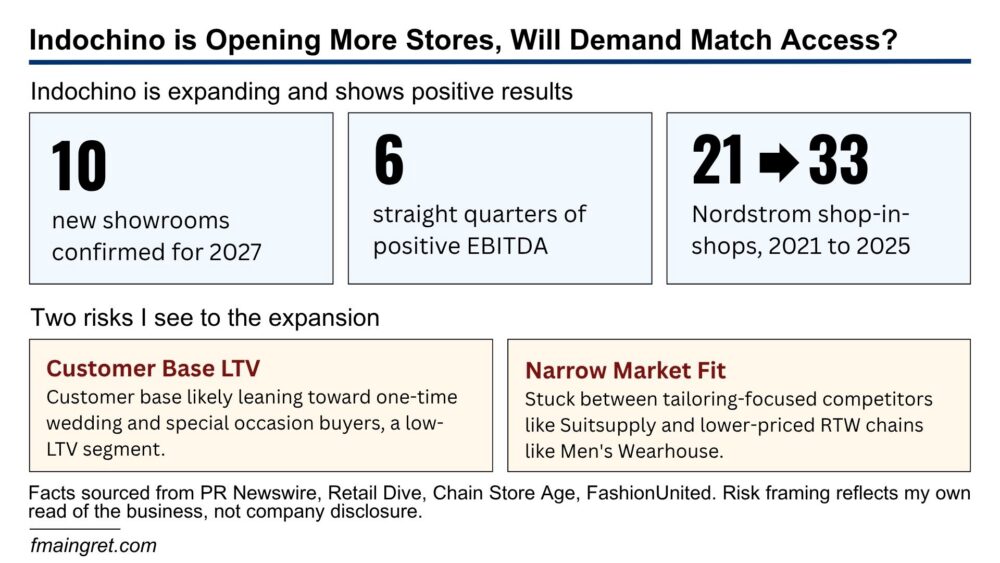
Today, the company has around 90 to 95 showrooms across the US and Canada, plus in-shop counters inside dozens of Nordstrom locations. And they’re not slowing down, the company just announced ten new US showrooms opening in 2027, after six straight quarters of positive EBITDA. What I find interesting is the smaller size of these stores, down from the 1,400 to 2,500 square feet of the initial showrooms, with some sources reporting that the new 2027 format will be as small as under 1,000 square feet. Smaller stores cost less to run, and a cheaper store means Indochino can expand its appointment-only model into more locations. Now, will the demand be there to fill all those new appointment calendars? That is the question that got me to write this post.
3 – Can Indochino’s Target Market Support the Expansion?
Who might be buying from Indochino? I don’t have access to internal data, but I assume weddings, celebrations, and to a lesser extent job interviews make up most of their customer base. The suit isn’t worn as much in 2026 than it was twenty years ago, and I would think these are often one-time purchases from customers with low lifetime value.
This isn’t the menswear enthusiast or the high-end professional lawyer or executive shopping here. The fit, with its slim fit cut, low to natural waist, flat front and skinny lapels, runs a little dated compared to where classic men’s style is today. More 2010s than 2020s. I believe this is by design and not a mistake, as Indochino customers are probably not looking for high waisted Gurkha trousers with reverse double pleats, and are chasing what they see in TV shows or social media outside of men’s style circles.
There’s little information on mills that provide the fabrics anywhere on the site, and not a lot of marketing around the tailoring experience itself, the thing that some customers see as the whole point of made-to-measure. Indochino customers are most likely buying a suit once every few years and won’t be picky when they do. Price sits in a reasonable range, not cheap (this can’t be the case with MTM), but not premium either.
There is one spot I found especially interesting: office wear. It’s a completely different purchase pattern than the wedding-suit audience, and I think it’s an incredible lever to build lifetime value. More on that in the next section.
The question the expansion has to answer is whether this customer base can actually support a hundred locations, and can Indochino compete against ready-to-wear chains like Men’s Wearhouse, or against suit rental services addressing a similar demographic. The smaller showroom format helps reduce costs, since the whole model does not need a ton of supplies or inventory, beyond some fabric swatches, and a few sample garments. Most customers are probably finding these stores online first anyway, so expensive prime real estate might be unnecessary.
But even a cheaper, smaller store needs enough appointments, and few people will walk past an Indochino storefront and impulse buy a custom made suit.
4 – What I Think Could Work for Indochino
The same principle that applies to Wayfair applies here: the store works in combination with the website, not competing with it for the same sale. I’d say that stores matter even more for Indochino and are a bigger part of the process. A suit that doesn’t fit isn’t forgiving, and letting customers self-measure for a custom order is a real risk. It is technically possible, but most people will either want the help and go elsewhere, or get it wrong and blame the brand for it later. So the store’s job is key, the measurements must be right. Not only this keeps the customer satisfied, but this saves a lot on reverse logistics and customer service. Growing lifetime value can however happen online once the customer has his measurements, but that’s the problem here if the customer only purchases one item for a wedding.
A business really only has three levers available to it: sell to more people, sell more to each person, or cut costs. There’s a fourth, raising prices, but I don’t think Indochino is in a position to pull that one right now given the competition. The smaller showroom format already helps with costs, so let’s look at the other two levers.
1. Don’t completely ignore the menswear enthusiast
Most guys who actually care about tailoring are in my opinion less likely to purchase from Indochino. Let me explain my reasoning here. As I wrote above, the cut and style are not what is popular in these niches today, and at this price point, competitors like Suitsupply or Enzo Custom might be favored options. More than the cut, these customers care about craftsmanship and materials.
Indochino claims to source from “premium mills” right there on the website, so why not say which ones? Why not show a few double-breasted cuts rather than the same one across the whole website? On other items like dress shirts, some details that matters to these enthusiasts are missing, such as the collar length. None of this requires pretending the brand has six hundred years of tailoring experience, just giving enough real detail to position the brand above Men’s Wearhouse. I pulled up one of their necktie pages recently and couldn’t tell whether it was made of silk, polyester, or something else. At fifty dollars, that’s not a small miss. It would not hurt the current customer base, but could attract new ones.
2. Push the office wear offer harder
The office category is a smart move, and I like that there’s also a B2B angle attached to it. There’s more long-term value sitting in this offer than in suits themselves, if you think about it. Few people in the US would buy a new suit every year (and those who do would buy elsewhere realistically), but plenty of white-collar workers would happily replace their work shirts frequently if the fit and the price were right.
Think of a guy who just graduated college and is preparing for job interviews. He gets measured, tries on a custom shirt while he’s there, notices it fits better than anything he owns off the rack. He may not be wearing a suit frequently, but he could be tempted to purchase a few shirts online every year by using the measurements the store gave him.
Let’s run the numbers on that scenario as an example. Indochino’s suits are priced at around $800, shirts at around $140. A customer who buys one suit for an interview and nothing else is worth $800, once. However, the customer who also purchases two office shirts a year for three years is worth $800 plus $840, more than double the original number, without even needing another store visit.
That’s a completely different purchase rhythm than the wedding crowd, and maybe one of the better ways to maximize LTV per customer. Cross-selling the two during that first visit, or at least coming up with a real follow-up afterward seems like an interesting tactic if the brand does not use it already.
3. Bring in the groomsmen too
Matching suits, shirts, and ties for the wedding party are already common. Right now, based on their website, that feels like an afterthought Indochino considered, but did not fully exploit. Why not make it a real group experience instead, get the whole party into the store on the same day, and give them a small discount? That’s not one suit sold, it’s four, six, maybe even ten similar suits in the same fabric, sold in a single visit.
There’s a second effect to these group appointments. A groomsman who gets fitted for someone else’s wedding is a guy who experiences the brand despite not being the one getting married. Plenty of those guys have never owned a suit or a shirt that actually fits them, and a good experience could turn into future orders, for a job interview, another wedding, or clothes for the office.
If even one appointment slot converts a $800 single sale into a $4000 group order, that means slightly higher fixed costs due to the extended appointment, but also generates several times the revenue. And if even one in five of those groomsmen becomes a repeat customer for a future interview or office wardrobe, the group booking also works towards much higher LTV.
5 – Conclusion
Opening retail stores for brands that started online are never purely competing with the online store. They are there in addition to the website and marketplaces, and add value to them. For Indochino it solves the problem of getting an accurate measurement and seeing the fabrics. But more locations only solve the access problem, the economics behind the model also have to work. While the company seems to be doing well and I am optimistic about its future, the scenarios we evaluated make me believe the real ceiling is the system in place rather than just market size. I am hoping that this expansion will bring in more synergies with online channels, ultimately resulting in even better results.
Sources: PR Newswire, Retail Dive, Chain Store Age, FashionUnited, Retail Insider