
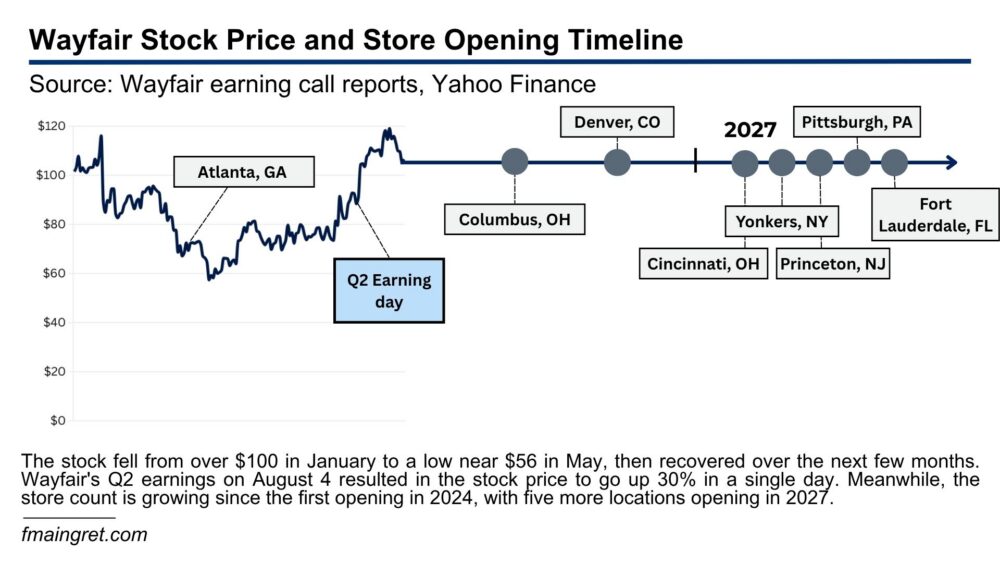
Wayfair’s CFO Kate Gulliver went on CNBC in early August to talk about the company’s growth over the past couple of years. She explained that Wayfair is taking market share from brick-and-mortar retailers, despite the housing market stalling and shoppers pulling back on discretionary purchases. At first glance, you’d read “Online still wins, retail loses”.
I don’t think Wayfair believes this story. The same quarter, the company was opening even more retail locations, and had just added Hal Lawton, the CEO of Tractor Supply and a former Macy’s executive, to its board. If the company really thought online is beating brick-and-mortar, I find it strange that the plan is to open more stores and bring more people from retail to their board.
I don’t think there is a contradiction here, and it would be a mistake to read the strategy as “online vs. retail”. The actual plan is more sophisticated than that, and can be applied to more than just Wayfair.
Where Wayfair Stands Today
The furniture and home goods industry is in a tough place these days, with high interest rates keeping the housing market frozen, and just fewer home sales. Retailers are fighting over a smaller pool of customers, and companies like Williams-Sonoma, Home Depot, or Lowe’s are feeling it. This is why I find Wayfair numbers especially interesting.
The numbers reported August 4 show:
- Revenue of $3.52B, up 7.5% year over year
- US segment specifically up 8.7% to $3.1B, Wayfair’s best US growth since 2020
- Orders up 6% year over year, and up more than 12% sequentially from Q1, the strongest sequential order growth Wayfair has posted in a Q2 since 2020
- Active customers up more than 3%, average order value up 1.2%
- Adjusted EBITDA of $242M, a 6.9% margin and the best since 2021
- Free cash flow of $301M, the best since Q2 2020
The headline number is revenue, $3.52B, up 7.5%. However, the number that I find more interesting is orders up more than 12% from Q1. Orders volume increasing by double digits, and active customers growing, means the company is able to reach new audiences. EBITDA margin at 6.9%, the best since 2021, tells us this growth isn’t being bought using discounts, but that we are seeing a real recovery here.
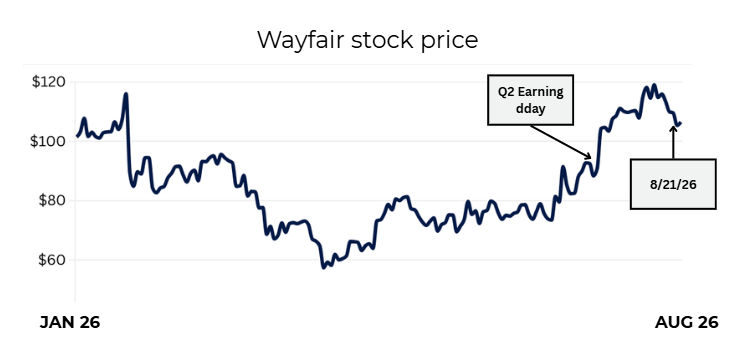
According to the company, this is not just one lucky quarter, Q3 guidance calls for high single digit revenue growth, assuming no improvement in the macro environment.
The store rollout is not just an experiment
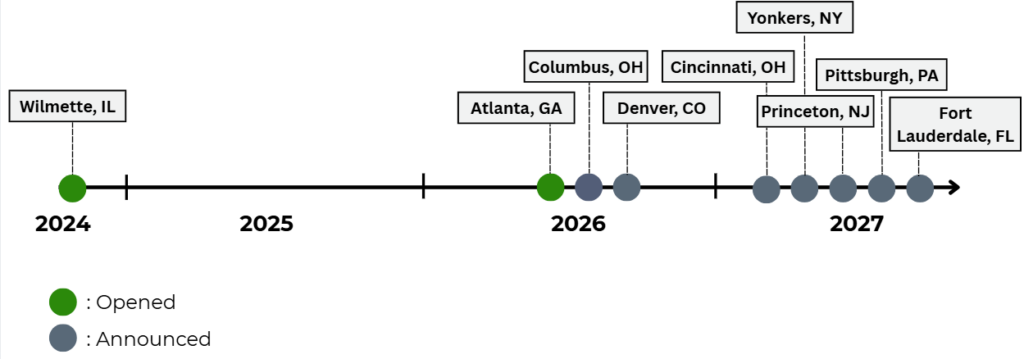
Now the part that surprised me initially, but makes a lot more sense today. Wayfair opened its first large format store in Wilmette, Illinois in May 2024, with 150,000 square feet positioned as a pilot.
Today, it is clear that it didn’t stay a pilot. A second store opened in Atlanta on March 31, 2026, same format. A third is coming to Denver in late 2026, and in July 2026, Wayfair announced five more for 2027. There’s also a smaller format store piloting in Columbus, Ohio in late 2026, which may tell us that Wayfair is trying to figure out how to scale this strategy past a few flagship locations.
For those unfamiliar with the company, let me explain how these stores operate. They don’t carry their own separate inventory the way a traditional furniture showroom does. You walk in, see and touch real products, you can work with an in-store designer, and the order you place still ships to your house through the same backend as an online order. Which means your order is either drop-shipped directly from the supplier or routed through CastleGate, Wayfair’s own fulfillment network. Wayfair spent a decade building logistics infrastructure so it could sell and ship furniture from partner suppliers without retail stores. Today, the company still does not own inventory and a working fulfillment model is already in place.
So why build these stores at all? According to the company but also outside analysts, Wayfair had real problems with the 100% online model. Active customers were declining, the growth was slowing down, AOV was subpar and margins were behind similar retailers with physical presence, including Williams-Sonoma, Home Depot, and Lowe’s. Improved logistics couldn’t fix the whole thing: offering next day delivery did not help selling a $3,000 couch the customer never had a chance to sit on.
Plus, if this all was just a side project , maybe for purely branding purposes, why bring Hal Lawton to the board? To me, that is a clear sign that retail and in-store expertise was needed.
The early data from the stores are positive, with more than half of new store customers completely new to Wayfair. This isn’t just about bringing online shoppers, the company is able to reach new customers. About 20% of store staff are trained interior designers, and they’re driving higher AOV compared to online purchases.
Why This Situation Should Not Be Framed as Retail vs Online
What I found the most interesting is the difference between the CNBC article and the earning call itself. On the call, and unlike in the news, CEO Niraj Shah didn’t credit the quarter to beating brick-and-mortar, but what he calls the “core recipe,” price, selection, delivery speed, product availability. He also credited some newer programs such as Wayfair Rewards, Wayfair Verified, Delivery Plus, and of course the stores, all combined.
And CFO Gulliver herself said, on the same call where she gave CNBC the brick-and-mortar line, that stores and the loyalty program are still “early in their ramp-up.” This is important information, and means that while the stores’ contribution today is still small relative to the online business, the real payoff has not shown up yet.
This is why I think framing it as “online vs. retail” is evaluating the distribution strategy on the wrong axis. Instead, we should look at the synergies between the two channels, and how they each play a different role in the overall strategy. For high consideration purchases like furniture, online and stores aren’t competing for the same function, but are part of the same funnel.
Stores are top and middle of the funnel, where a stranger either becomes aware of Wayfair as a real, trustworthy furniture company, or finally considers a company they would not buy from their website. They can also get talked through a purchase by an actual designer, reaching the conversion stage.
On the other hand, online handles most of the bottom of the funnel. It’s where that trust, once established, gets monetized profitably through retention, reorders, the rewards program, and the purchases that don’t need a showroom visit to close. It is also where a portion of the customers create content on their experience and may get other people to give Wayfair a try.
I have written about it when analyzing other businesses with a multichannel approach, discovery and trust don’t have to happen in the same channel where the conversion happens. Furniture makes the plan more visible than most categories, because the stakes of buying wrong (for the customer but also the retailer) are so much higher than a t-shirt or a bar of soap.
This is why Wayfair’s stores were never meant to be a second revenue stream competing with the website for the same customers. The company had some issues specific to the industry, with a portion of customers wanting to see and feel the furniture before buying. The stores are the strategic asset, expensive and slow to scale, that pays off by bringing in new customers, and establishing a long term, multichannel relationship with them.
| Stores | Online | |
|---|---|---|
| Funnel stage | Top-middle of funnel | Whole funnel |
| Primary job | Reaching new customers, conversions | Retention and monetization, turning customers into repeat buyers and brand advocates |
| What it’s optimized for | Trust-building for high-consideration purchases, brand experience, staff helping with conversions | Speed and convenience for decided buyers, repeat purchases, long tail of smaller orders, legacy customers |
| Evidence from Wayfair’s numbers | Over 50% of new in-store customers are new to Wayfair’s | Loyalty program (Wayfair Rewards), reorders, and the existing base drive the bulk of revenue |
| Cost structure | High fixed cost, real estate, staff, slow to scale | Highly scalable, lower fixed costs, CAC unknown |
| What it’s not | Not a standalone profit center at this stage | Not where new customer relationships typically start for this category industry |
Conclusion
Which line is true? I’d say both. “We’re beating brick-and-mortar” is a great line for CNBC, and is true in regards to the company’s growth compared to competitors with a heavier retail focus. But Wayfair is also quietly becoming a bit of a brick-and-mortar retailer.
The real question is whether this is a structural industry requirement, or a phase large online retailers need once they hit a wall with customer acquisition. My guess is this is structural. The trust requirements in high-consideration categories stays even after the company matures, and can’t be ignored if a company wants to broaden its reach. This is why I am not surprised to see this coming even from a brand that originates from the online world.
Source: Wayfair Q2 2026 earnings call and investor materials, CNBC, Yahoo Finance, Retail Dive, Chain Store Age, PR Newswire, stockanalysis.com